Switch Wiring Diagram
Pick a layout and where power comes in to see every wire, screw and splice.
Rule of thumbA 3-way switch has a dark common screw (power in at one switch, out to the light at the other) and 2 brass traveler screws.
Breaker off. Test wires dead. Unsure? Call an electrician.
Drawn with the power coming in at the switch.
This is one common way to wire this layout in a US home. Old wiring, odd colours, aluminum wire, no ground wire or a smart switch can change it. If your box doesn't match, stop and call a licensed electrician.
Many towns need a permit for wiring work, and some don't let homeowners do it. Check with your building department.
LIGHT ON
Tested: all 4 switch positions
Either traveler can go on either brass screw. The dark screw is the common.
The wires in words
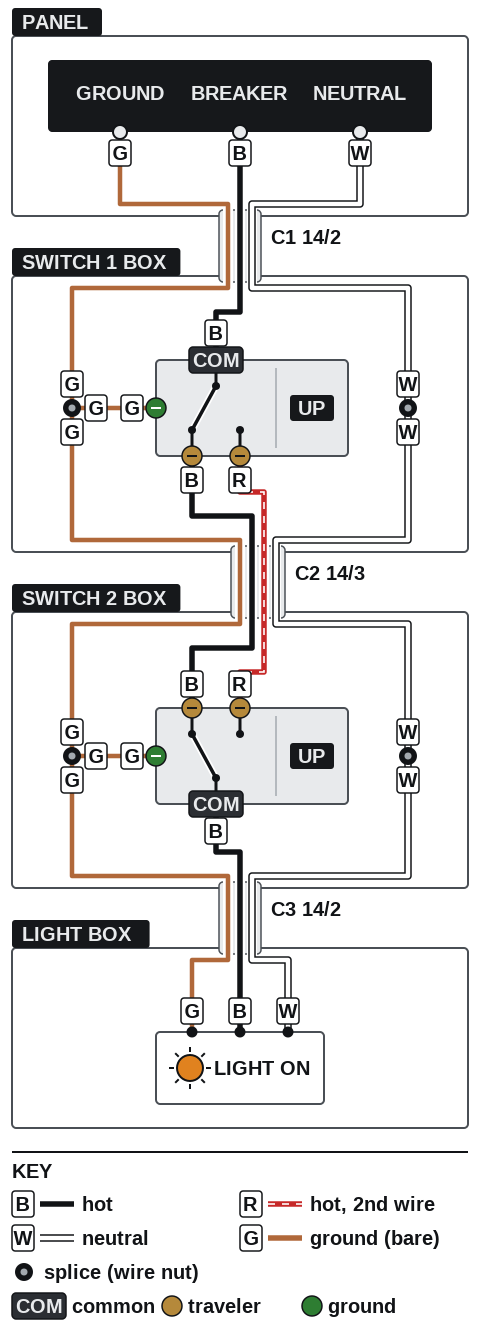
- Cable C1 (14/2 with ground), panel to switch 1 box: black is the constant hot, from the breaker to switch 1's dark common (COM) screw; white is the neutral, from the neutral bar to the neutral splice in the switch 1 box; bare is the ground, from the ground bar to the ground splice in the switch 1 box.
- Cable C2 (14/3 with ground), switch 1 box to switch 2 box: black is a traveler, from switch 1's brass traveler screw to switch 2's brass traveler screw; red is a traveler, from switch 1's brass traveler screw to switch 2's brass traveler screw; white is the neutral, from the neutral splice in the switch 1 box to the neutral splice in the switch 2 box; bare is the ground, from the ground splice in the switch 1 box to the ground splice in the switch 2 box.
- Cable C3 (14/2 with ground), switch 2 box to light box: black is the switched hot, from switch 2's dark common (COM) screw to the light's hot lead; white is the neutral, from the neutral splice in the switch 2 box to the light's neutral lead; bare is the ground, from the ground splice in the switch 2 box to the light's ground.
- Neutral splice, switch 1 box: white from cable C1 and white from cable C2.
- Ground splice, switch 1 box: bare from cable C1, a bare pigtail to switch 1's green ground screw and bare from cable C2.
- Neutral splice, switch 2 box: white from cable C2 and white from cable C3.
- Ground splice, switch 2 box: bare from cable C2, a bare pigtail to switch 2's green ground screw and bare from cable C3.
Sources for this layout
Either traveler can go on either brass screw. The dark screw is the common.
- Cable C1 (14/2 with ground), panel to switch 1 box: black is the constant hot, from the breaker to switch 1's dark common (COM) screw; white is the neutral, from the neutral bar to the neutral splice in the switch 1 box; bare is the ground, from the ground bar to the ground splice in the switch 1 box.
- Cable C2 (14/3 with ground), switch 1 box to switch 2 box: black is a traveler, from switch 1's brass traveler screw to switch 2's brass traveler screw; red is a traveler, from switch 1's brass traveler screw to switch 2's brass traveler screw; white is the neutral, from the neutral splice in the switch 1 box to the neutral splice in the switch 2 box; bare is the ground, from the ground splice in the switch 1 box to the ground splice in the switch 2 box.
- Cable C3 (14/2 with ground), switch 2 box to light box: black is the switched hot, from switch 2's dark common (COM) screw to the light's hot lead; white is the neutral, from the neutral splice in the switch 2 box to the light's neutral lead; bare is the ground, from the ground splice in the switch 2 box to the light's ground.
- Neutral splice, switch 1 box: white from cable C1 and white from cable C2.
- Ground splice, switch 1 box: bare from cable C1, a bare pigtail to switch 1's green ground screw and bare from cable C2.
- Neutral splice, switch 2 box: white from cable C2 and white from cable C3.
- Ground splice, switch 2 box: bare from cable C2, a bare pigtail to switch 2's green ground screw and bare from cable C3.
- Leviton 5603 3-way switch instruction sheet (PDF)amazonaws.com
- Purdue Extension, 4-H Electric Level 5: wiring diagrams for 3-way and 4-way switches (PDF)purdue.edu
- Family Handyman, How to wire a 3-way switchfamilyhandyman.com
One common way; your cable runs may differ. Only switch 1's box has a neutral here.
In a 3-way or 4-way run, one switch box with a neutral can be enough (NEC 404.2(C)).
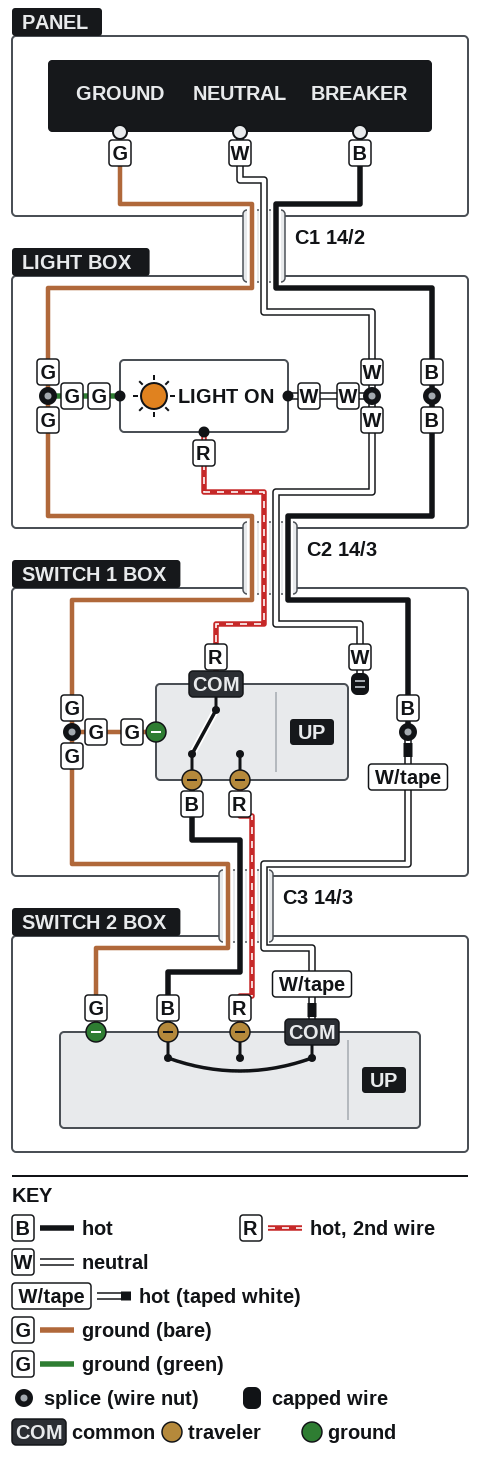
- Cable C1 (14/2 with ground), panel to light box: black is the constant hot, from the breaker to the hot splice in the light box; white is the neutral, from the neutral bar to the neutral splice in the light box; bare is the ground, from the ground bar to the ground splice in the light box.
- Cable C2 (14/3 with ground), light box to switch 1 box: black is the constant hot, from the hot splice in the light box to the hot splice in the switch 1 box; red is the switched hot, from switch 1's dark common (COM) screw to the light's hot lead; white is the neutral, from the neutral splice in the light box to a cap (wire nut) in the switch 1 box; bare is the ground, from the ground splice in the light box to the ground splice in the switch 1 box.
- Cable C3 (14/3 with ground), switch 1 box to switch 2 box: white taped black is the constant hot, from the hot splice in the switch 1 box to switch 2's dark common (COM) screw; black is a traveler, from switch 1's brass traveler screw to switch 2's brass traveler screw; red is a traveler, from switch 1's brass traveler screw to switch 2's brass traveler screw; bare is the ground, from the ground splice in the switch 1 box to switch 2's green ground screw.
- Hot splice, light box: black from cable C1 and black from cable C2.
- Neutral splice, light box: white from cable C1, the light's white lead and white from cable C2.
- Ground splice, light box: bare from cable C1, the light's green ground lead and bare from cable C2.
- Hot splice, switch 1 box: black from cable C2 and white taped black from cable C3.
- Ground splice, switch 1 box: bare from cable C2, a bare pigtail to switch 1's green ground screw and bare from cable C3.
- Cap, switch 1 box: white from cable C2, capped with a wire nut and not used.
- Purdue Extension, 4-H Electric Level 5: wiring diagrams for 3-way and 4-way switches (PDF)purdue.edu
- Leviton 5603 3-way switch instruction sheet (PDF)amazonaws.com
- Fine Homebuilding, Wiring a switch loopfinehomebuilding.com
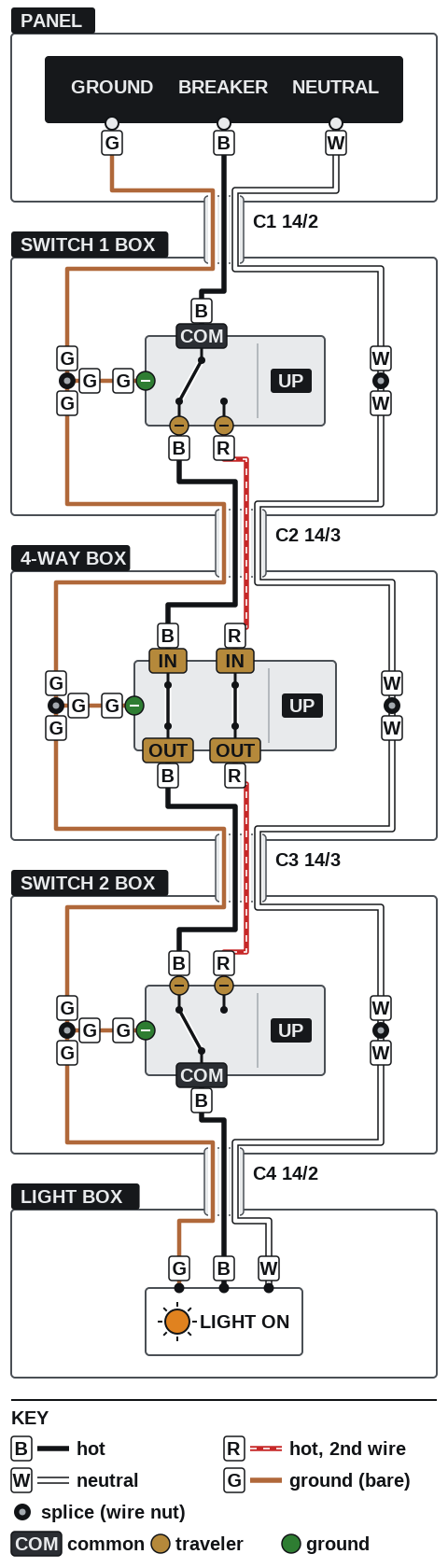
The 4-way's IN pair takes the travelers from switch 1 and its OUT pair sends them on. Follow your switch's markings.
- Cable C1 (14/2 with ground), panel to switch 1 box: black is the constant hot, from the breaker to switch 1's dark common (COM) screw; white is the neutral, from the neutral bar to the neutral splice in the switch 1 box; bare is the ground, from the ground bar to the ground splice in the switch 1 box.
- Cable C2 (14/3 with ground), switch 1 box to 4-way box: black is a traveler, from switch 1's brass traveler screw to the 4-way's IN screw; red is a traveler, from switch 1's brass traveler screw to the 4-way's IN screw; white is the neutral, from the neutral splice in the switch 1 box to the neutral splice in the 4-way box; bare is the ground, from the ground splice in the switch 1 box to the ground splice in the 4-way box.
- Cable C3 (14/3 with ground), 4-way box to switch 2 box: black is a traveler, from the 4-way's OUT screw to switch 2's brass traveler screw; red is a traveler, from the 4-way's OUT screw to switch 2's brass traveler screw; white is the neutral, from the neutral splice in the 4-way box to the neutral splice in the switch 2 box; bare is the ground, from the ground splice in the 4-way box to the ground splice in the switch 2 box.
- Cable C4 (14/2 with ground), switch 2 box to light box: black is the switched hot, from switch 2's dark common (COM) screw to the light's hot lead; white is the neutral, from the neutral splice in the switch 2 box to the light's neutral lead; bare is the ground, from the ground splice in the switch 2 box to the light's ground.
- Neutral splice, switch 1 box: white from cable C1 and white from cable C2.
- Ground splice, switch 1 box: bare from cable C1, a bare pigtail to switch 1's green ground screw and bare from cable C2.
- Neutral splice, 4-way box: white from cable C2 and white from cable C3.
- Ground splice, 4-way box: bare from cable C2, a bare pigtail to the 4-way's green ground screw and bare from cable C3.
- Neutral splice, switch 2 box: white from cable C3 and white from cable C4.
- Ground splice, switch 2 box: bare from cable C3, a bare pigtail to switch 2's green ground screw and bare from cable C4.
- Leviton 4-way switch instruction sheet (PDF)thdstatic.com
- Purdue Extension, 4-H Electric Level 5: wiring diagrams for 3-way and 4-way switches (PDF)purdue.edu
- Leviton 5603 3-way switch instruction sheet (PDF)amazonaws.com
One common way; your cable runs may differ. Only switch 1's box has a neutral here.
In a 3-way or 4-way run, one switch box with a neutral can be enough (NEC 404.2(C)).
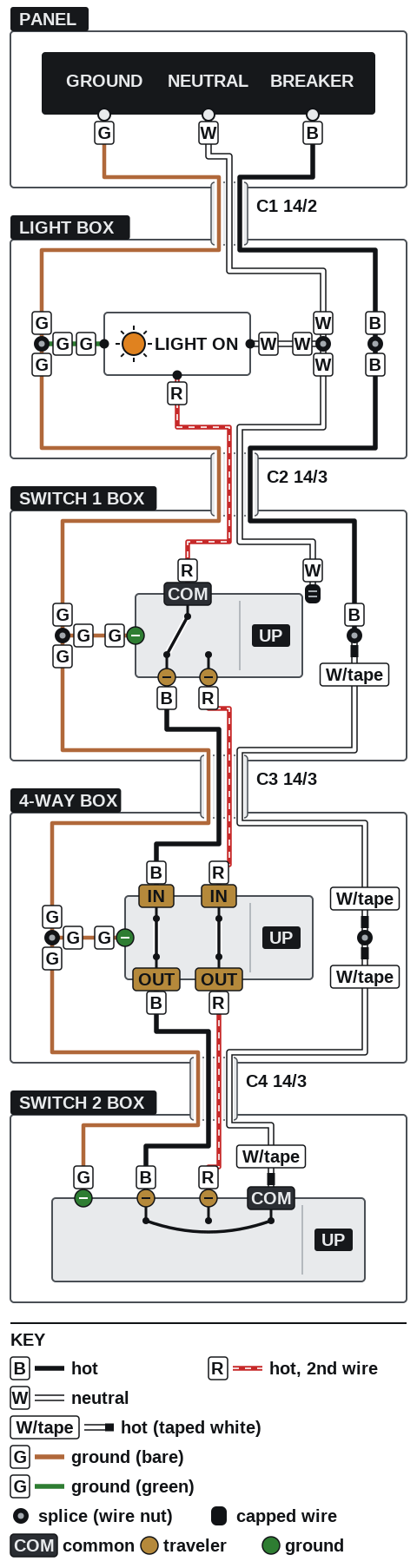
- Cable C1 (14/2 with ground), panel to light box: black is the constant hot, from the breaker to the hot splice in the light box; white is the neutral, from the neutral bar to the neutral splice in the light box; bare is the ground, from the ground bar to the ground splice in the light box.
- Cable C2 (14/3 with ground), light box to switch 1 box: black is the constant hot, from the hot splice in the light box to the hot splice in the switch 1 box; red is the switched hot, from switch 1's dark common (COM) screw to the light's hot lead; white is the neutral, from the neutral splice in the light box to a cap (wire nut) in the switch 1 box; bare is the ground, from the ground splice in the light box to the ground splice in the switch 1 box.
- Cable C3 (14/3 with ground), switch 1 box to 4-way box: white taped black is the constant hot, from the hot splice in the switch 1 box to the hot splice in the 4-way box; black is a traveler, from switch 1's brass traveler screw to the 4-way's IN screw; red is a traveler, from switch 1's brass traveler screw to the 4-way's IN screw; bare is the ground, from the ground splice in the switch 1 box to the ground splice in the 4-way box.
- Cable C4 (14/3 with ground), 4-way box to switch 2 box: white taped black is the constant hot, from the hot splice in the 4-way box to switch 2's dark common (COM) screw; black is a traveler, from the 4-way's OUT screw to switch 2's brass traveler screw; red is a traveler, from the 4-way's OUT screw to switch 2's brass traveler screw; bare is the ground, from the ground splice in the 4-way box to switch 2's green ground screw.
- Hot splice, light box: black from cable C1 and black from cable C2.
- Neutral splice, light box: white from cable C1, the light's white lead and white from cable C2.
- Ground splice, light box: bare from cable C1, the light's green ground lead and bare from cable C2.
- Hot splice, switch 1 box: black from cable C2 and white taped black from cable C3.
- Ground splice, switch 1 box: bare from cable C2, a bare pigtail to switch 1's green ground screw and bare from cable C3.
- Cap, switch 1 box: white from cable C2, capped with a wire nut and not used.
- Hot splice, 4-way box: white taped black from cable C3 and white taped black from cable C4.
- Ground splice, 4-way box: bare from cable C3, a bare pigtail to the 4-way's green ground screw and bare from cable C4.
- Purdue Extension, 4-H Electric Level 5: wiring diagrams for 3-way and 4-way switches (PDF)purdue.edu
- Leviton 4-way switch instruction sheet (PDF)thdstatic.com
- Fine Homebuilding, Wiring a switch loopfinehomebuilding.com
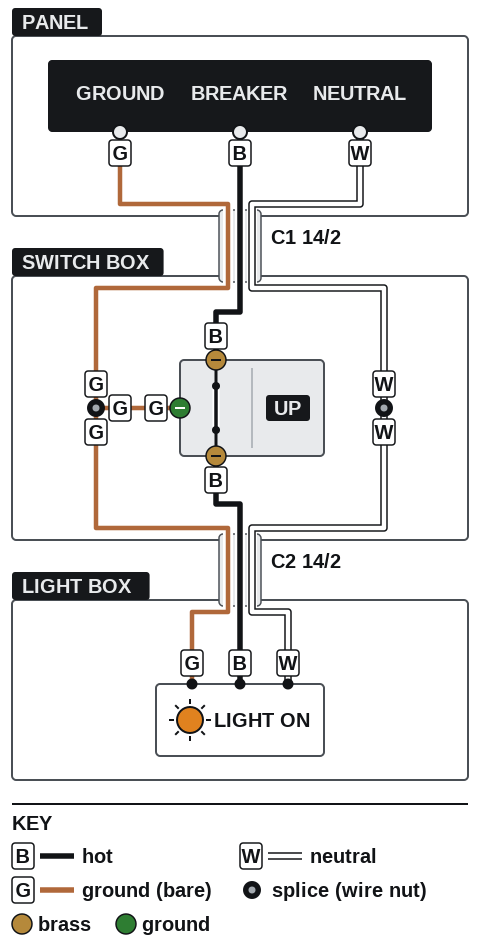
The whites are spliced in the switch box: a plain switch never connects to the neutral.
- Cable C1 (14/2 with ground), panel to switch box: black is the constant hot, from the breaker to the switch's brass screw; white is the neutral, from the neutral bar to the neutral splice in the switch box; bare is the ground, from the ground bar to the ground splice in the switch box.
- Cable C2 (14/2 with ground), switch box to light box: black is the switched hot, from the switch's brass screw to the light's hot lead; white is the neutral, from the neutral splice in the switch box to the light's neutral lead; bare is the ground, from the ground splice in the switch box to the light's ground.
- Neutral splice, switch box: white from cable C1 and white from cable C2.
- Ground splice, switch box: bare from cable C1, a bare pigtail to the switch's green ground screw and bare from cable C2.
- Fine Homebuilding, Wiring a switch loopfinehomebuilding.com
- Family Handyman, How to wire a 3-way switchfamilyhandyman.com
- Leviton 5603 3-way switch instruction sheet (PDF)amazonaws.com
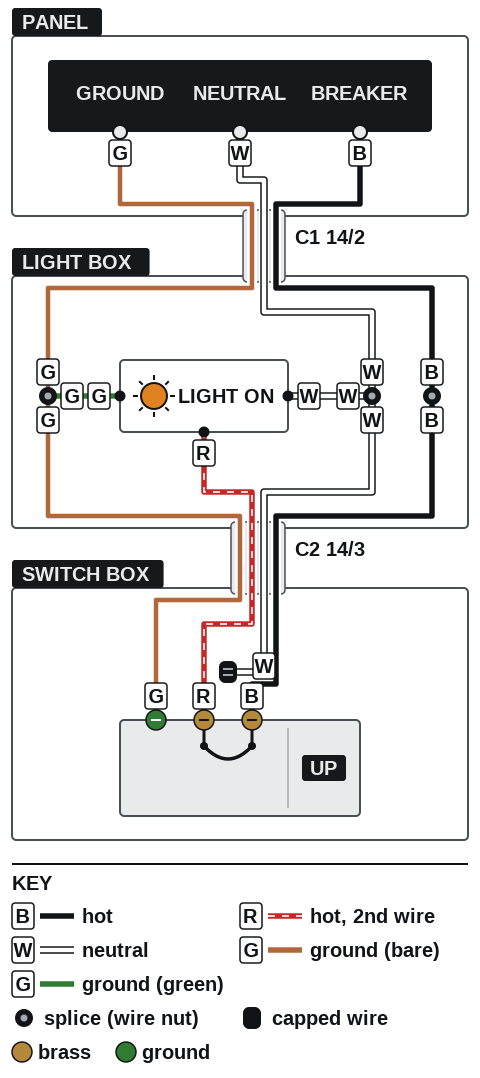
The white in the switch box is capped. A plain switch does not use it; a smart switch may need it.
- Cable C1 (14/2 with ground), panel to light box: black is the constant hot, from the breaker to the hot splice in the light box; white is the neutral, from the neutral bar to the neutral splice in the light box; bare is the ground, from the ground bar to the ground splice in the light box.
- Cable C2 (14/3 with ground), light box to switch box: black is the constant hot, from the hot splice in the light box to the switch's brass screw; red is the switched hot, from the switch's brass screw to the light's hot lead; white is the neutral, from the neutral splice in the light box to a cap (wire nut) in the switch box; bare is the ground, from the ground splice in the light box to the switch's green ground screw.
- Hot splice, light box: black from cable C1 and black from cable C2.
- Neutral splice, light box: white from cable C1, the light's white lead and white from cable C2.
- Ground splice, light box: bare from cable C1, the light's green ground lead and bare from cable C2.
- Cap, switch box: white from cable C2, capped with a wire nut and not used.
- Fine Homebuilding, Wiring a switch loopfinehomebuilding.com
- Leviton 5246 3-way switch and pilot light instruction sheet (PDF)amazonaws.com
- Purdue Extension, 4-H Electric Level 5: wiring diagrams for 3-way and 4-way switches (PDF)purdue.edu
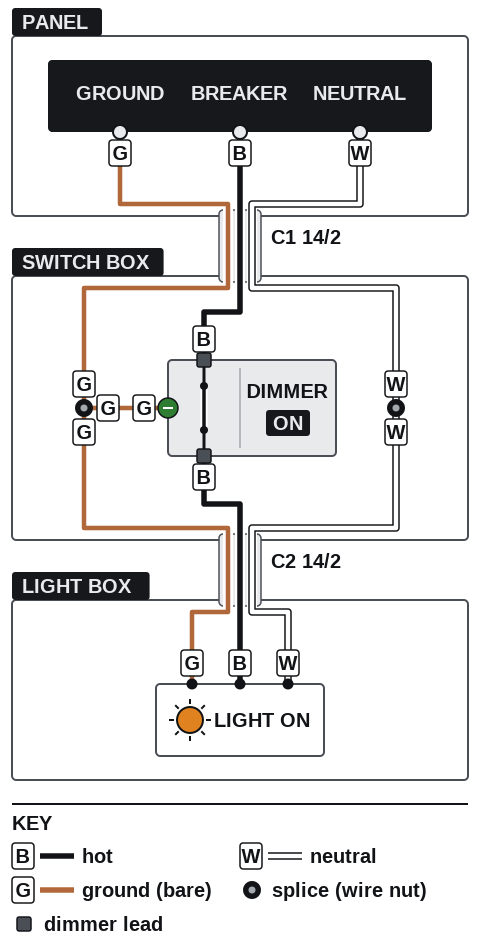
Follow the dimmer's own sheet: some need a neutral, and many allow only one dimmer per 3-way circuit.
The dimmer is shown at full on.
- Cable C1 (14/2 with ground), panel to switch box: black is the constant hot, from the breaker to one of the dimmer's leads; white is the neutral, from the neutral bar to the neutral splice in the switch box; bare is the ground, from the ground bar to the ground splice in the switch box.
- Cable C2 (14/2 with ground), switch box to light box: black is the switched hot, from one of the dimmer's leads to the light's hot lead; white is the neutral, from the neutral splice in the switch box to the light's neutral lead; bare is the ground, from the ground splice in the switch box to the light's ground.
- Neutral splice, switch box: white from cable C1 and white from cable C2.
- Ground splice, switch box: bare from cable C1, a bare pigtail to the dimmer's green ground lead and bare from cable C2.
- Lutron Diva DVCL-153P dimmer installation sheet (PDF)1000bulbs.com
- Lutron Diva DV-103P dimmer instructions (PDF)1000bulbs.com
- Leviton 5246 3-way switch and pilot light instruction sheet (PDF)amazonaws.com
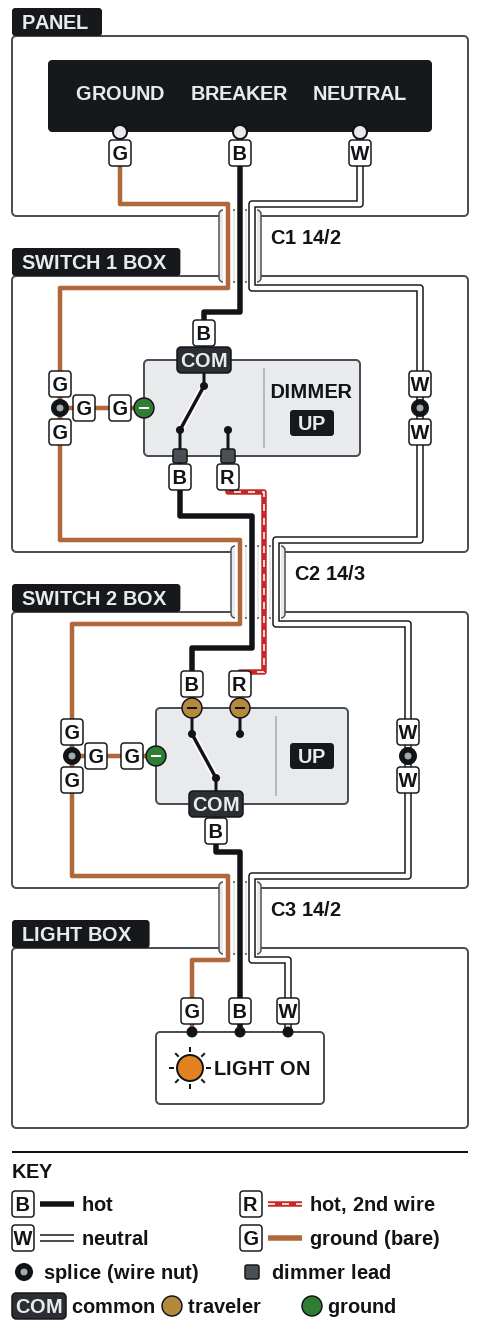
Follow the dimmer's own sheet: some need a neutral, and many allow only one dimmer per 3-way circuit.
Which switch it replaces and which lead is the common: the dimmer's own sheet.
- Cable C1 (14/2 with ground), panel to switch 1 box: black is the constant hot, from the breaker to the dimmer's common lead; white is the neutral, from the neutral bar to the neutral splice in the switch 1 box; bare is the ground, from the ground bar to the ground splice in the switch 1 box.
- Cable C2 (14/3 with ground), switch 1 box to switch 2 box: black is a traveler, from a traveler lead of the dimmer to switch 2's brass traveler screw; red is a traveler, from a traveler lead of the dimmer to switch 2's brass traveler screw; white is the neutral, from the neutral splice in the switch 1 box to the neutral splice in the switch 2 box; bare is the ground, from the ground splice in the switch 1 box to the ground splice in the switch 2 box.
- Cable C3 (14/2 with ground), switch 2 box to light box: black is the switched hot, from switch 2's dark common (COM) screw to the light's hot lead; white is the neutral, from the neutral splice in the switch 2 box to the light's neutral lead; bare is the ground, from the ground splice in the switch 2 box to the light's ground.
- Neutral splice, switch 1 box: white from cable C1 and white from cable C2.
- Ground splice, switch 1 box: bare from cable C1, a bare pigtail to the dimmer's green ground lead and bare from cable C2.
- Neutral splice, switch 2 box: white from cable C2 and white from cable C3.
- Ground splice, switch 2 box: bare from cable C2, a bare pigtail to switch 2's green ground screw and bare from cable C3.
- Lutron Diva DVCL-153P dimmer installation sheet (PDF)1000bulbs.com
- Lutron Diva DV-103P dimmer instructions (PDF)1000bulbs.com
- Leviton 5603 3-way switch instruction sheet (PDF)amazonaws.com
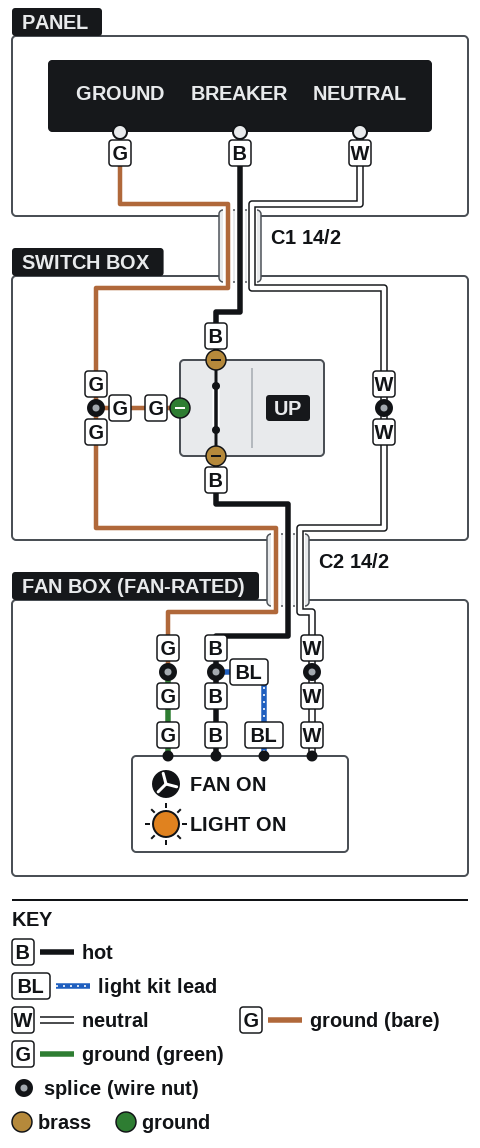
Hang the fan only from a box marked for fan support. Colours vary by maker: follow your fan's manual.
The pull chains then work the fan speed and the light.
- Cable C1 (14/2 with ground), panel to switch box: black is the constant hot, from the breaker to the switch's brass screw; white is the neutral, from the neutral bar to the neutral splice in the switch box; bare is the ground, from the ground bar to the ground splice in the switch box.
- Cable C2 (14/2 with ground), switch box to fan box (fan-rated): black is the switched hot, from the switch's brass screw to the fan splice in the fan box (fan-rated); white is the neutral, from the neutral splice in the switch box to the neutral splice in the fan box (fan-rated); bare is the ground, from the ground splice in the switch box to the ground splice in the fan box (fan-rated).
- Neutral splice, switch box: white from cable C1 and white from cable C2.
- Ground splice, switch box: bare from cable C1, a bare pigtail to the switch's green ground screw and bare from cable C2.
- Fan splice, fan box (fan-rated): black from cable C2, the fan's black motor lead and the fan's blue light kit lead.
- Neutral splice, fan box (fan-rated): white from cable C2 and the fan's white lead.
- Ground splice, fan box (fan-rated): bare from cable C2 and the fan's green ground lead.
- Hunter ceiling fan installation manual 3617-01 (PDF)hunterfan.com
- Hunter ceiling fan installation manual M3504-01 (PDF)hunterfan.com
- Ceiling fan instruction manual, Lowe's document 64119990 (PDF)lowes.com
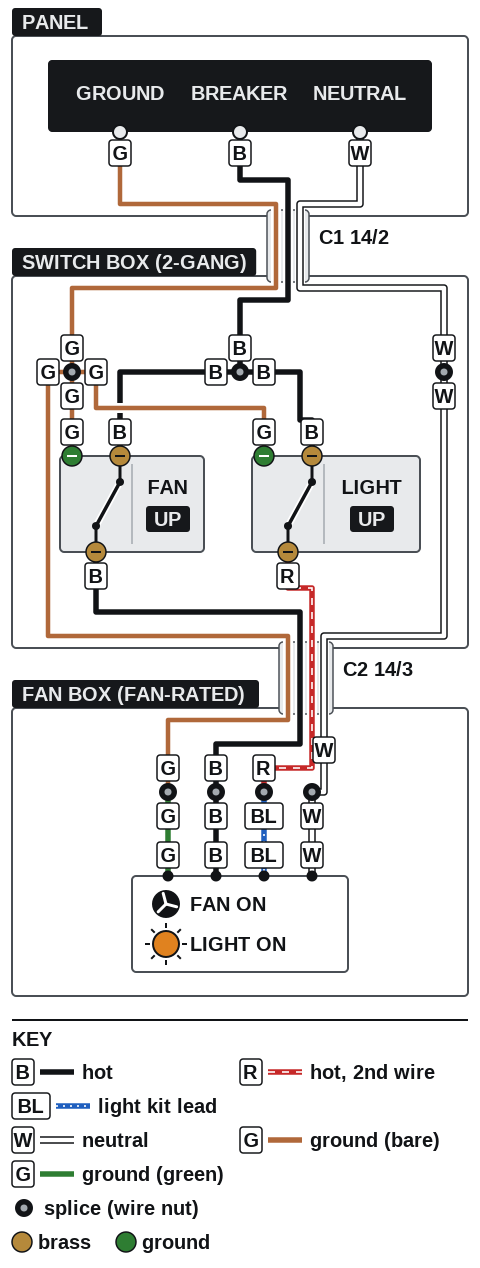
Hang the fan only from a box marked for fan support. Colours vary by maker: follow your fan's manual.
Red to the light kit is a common habit. Your fan's manual names its light lead.
- Cable C1 (14/2 with ground), panel to switch box (2-gang): black is the constant hot, from the breaker to the hot splice in the switch box (2-gang); white is the neutral, from the neutral bar to the neutral splice in the switch box (2-gang); bare is the ground, from the ground bar to the ground splice in the switch box (2-gang).
- Cable C2 (14/3 with ground), switch box (2-gang) to fan box (fan-rated): black is the switched hot for the fan, from the fan switch's brass screw to the motor splice in the fan box (fan-rated); red is the switched hot for the light, from the light switch's brass screw to the light kit splice in the fan box (fan-rated); white is the neutral, from the neutral splice in the switch box (2-gang) to the neutral splice in the fan box (fan-rated); bare is the ground, from the ground splice in the switch box (2-gang) to the ground splice in the fan box (fan-rated).
- Hot splice, switch box (2-gang): black from cable C1, a black pigtail to the fan switch's brass screw and a black pigtail to the light switch's brass screw.
- Neutral splice, switch box (2-gang): white from cable C1 and white from cable C2.
- Ground splice, switch box (2-gang): bare from cable C1, a bare pigtail to the fan switch's green ground screw, a bare pigtail to the light switch's green ground screw and bare from cable C2.
- Motor splice, fan box (fan-rated): black from cable C2 and the fan's black motor lead.
- Light kit splice, fan box (fan-rated): red from cable C2 and the fan's blue light kit lead.
- Neutral splice, fan box (fan-rated): white from cable C2 and the fan's white lead.
- Ground splice, fan box (fan-rated): bare from cable C2 and the fan's green ground lead.
3-way switch wiring: what goes on each screw
Two 3-way switches run one light: each joins its common screw to one of 2 travelers (the wires between them), so the light is on when both pick the same traveler and flipping either one changes it. Each has 3 screws plus a green ground. The dark common takes the power at one switch and feeds the light at the other. The travelers, black and red in 14/3 cable (three 14 AWG wires plus a bare ground), go on either brass screw. The white neutral (the return wire) is spliced, never on a switch: 3-way and 4-way switches only switch the hot (NEC 404.2(A)). Use 14/2 and 14/3 on a 15 A circuit, 12/2 and 12/3 on 20 A (wire size calculator). Outside North America the same switch is usually called a 2-way switch.
Power at the switch or the light?
Find the box the panel’s cable enters first: a switch box means power at the switch, the light box power at the light. Confirm it with a tester.
3-way switch with power at the light
With power at the light, the cables run light box, switch 1, switch 2. The 14/3 from the light carries the hot down on black and the switched hot back on red. Between the switches the white, taped black at both ends, brings power to switch 2’s common; a taped white may only be the supply to a switch, never the return to the light (NEC 200.7(C)(1)). Only switch 1’s box has a neutral, capped. This is one common way: your cable runs may differ.
4-way switch wiring for three or more switches
To run one light from 3 switches, put a 4-way switch between two 3-way switches on the 2 travelers. It passes them straight through or crosses them, so any switch flips the light. Leviton’s 4-way sheet marks one screw pair IN and one OUT: travelers from switch 1 on one pair, to switch 2 on the other. Follow your switch’s markings; more 4-ways in the traveler run add more places.
Light switch wiring: single-pole and the switch loop
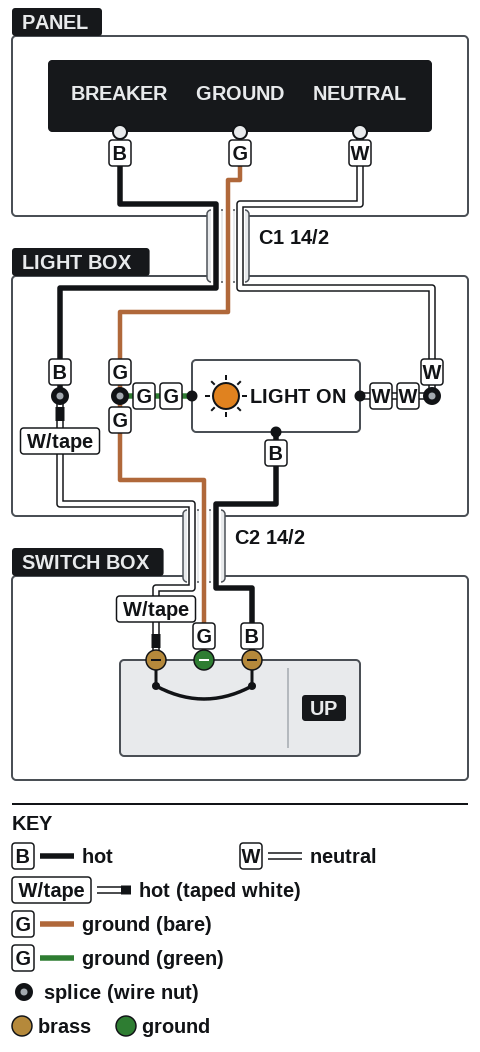
A single-pole light switch has 2 brass screws and a ground. Power at the switch: the panel’s black goes on one screw, the light’s black on the other, and the whites are spliced. Power at the light: 14/3 runs down, black brings the hot, red takes it back, and the white is capped. Older houses may have a 2-wire loop with a taped white (drawn below). Newer editions of the NEC generally want a neutral in the switch box for room lighting (NEC 404.2(C); section 406.30 in the 2026 edition). For several lights on one switch, the recessed lighting calculator adds up their watts.
Electrical wire color code for switch wiring
In US home cable, black and red are hots, white or gray is the neutral, and bare or green is the ground. A colour is a clue, not proof: test it.
| Colour | Job | Rule |
|---|---|---|
| Black | Hot | Main hot |
| Red | Second hot | Traveler or switched wire |
| White or gray | Neutral | NEC 200.6(A) |
| White taped black or red | Hot | NEC 200.7(C)(1): marked at both ends |
| Bare or green | Ground | NEC 250.119 |
| Blue | Extra hot | 4-wire cable, or a fan’s light kit lead |
Ceiling fan wiring with a light: one switch or two
Fan leads are usually black (motor), blue (light), white and green. On one switch, the fan’s black and blue join the switched hot. On two switches, run 14/3: black to the motor, red to the blue light lead. Hang a fan only from a box marked for fan support. A light dimmer is not a fan speed control (Hunter). Colours vary by maker: the fan’s manual wins. Some towns, Bend in Oregon among them, need a permit to swap a light for a fan.
Dimmer switch wiring
A dimmer takes the same wires as the switch it replaces, often on leads instead of screws: its sheet says which lead goes where. Some devices, such as Leviton’s 5246 lighted switch, need a neutral; Lutron’s DVCL-153P does not. On a 3-way, Lutron’s Diva sheets allow one dimmer; the other place keeps a 3-way switch. Tag the wire on the old switch’s dark screw first.
When to stop and call an electrician
Stop and call a licensed electrician if:
- there is no bare or green ground wire;
- the wire is aluminum (some homes built about 1965 to the mid-1970s): the CPSC says not to repair it yourself, and ordinary switches take copper only;
- the wire is cloth-covered or knob-and-tube;
- colours or taped whites don’t match the drawing;
- the box holds more cables than the drawing;
- the light box sits between the two switches (not drawn: there are several versions, one with 4-wire cable);
- the switch is warm, buzzing or scorched;
- the box is crowded (check the box fill calculator).
How to read a wiring diagram
Each line is one wire in its real colour, tagged at both ends. A black dot is a splice (wire nut); black bands on a white line mean tape. Grey outlines are boxes; “C2 14/3” names a cable; COM, IN and OUT name screws.
How these diagrams are drawn and tested
Every drawing here is this site’s own, made by code from a list of every wire. A test runs every switch position of every layout: the light does what the drawing says, no position joins the hot to the neutral or ground, every switch and fixture is grounded, and each cable carries its current out and back. The wiring follows the maker sheets and Purdue Extension guide listed per layout. Found a mistake? Email [email protected] and I’ll fix it.
All switch wiring diagrams
Questions people ask
What is the red wire in a switch box?
The red wire is the second hot in 3-wire (14/3) cable: one of the 2 travelers between 3-way switches, or the switched wire to the light. It is never a neutral.
How many wires does a ceiling fan have?
Most ceiling fans with a light have 4 wires: black for the motor, blue for the light, white neutral and green ground. Colours vary by maker, so read the fan's manual.
Can I put a dimmer on a 3-way switch?
Yes, 1 dimmer per 3-way circuit for a standard dimmer such as Lutron's Diva; the other place keeps a 3-way switch. The dimmer's sheet says which switch it replaces and which lead is the common.
Do I need a neutral wire at the light switch?
NEC 404.2(C) generally wants a neutral in switch boxes for room lighting. A plain switch never connects to it (the whites are spliced or capped); smart switches and some dimmers do.
What size wire does a light switch need?
14 AWG copper on a 15 A breaker and 12 AWG on a 20 A breaker (NEC 240.4(D)). Match the cable already on the circuit.
Related calculators
Sources
- Purdue Extension, 4-H Electric Level 5: wiring diagrams for 3-way and 4-way switches (PDF)purdue.edu
- Leviton 5603 3-way switch instruction sheet (PDF)amazonaws.com
- Leviton 4-way switch instruction sheet (PDF)thdstatic.com
- Leviton 5246 3-way switch and pilot light instruction sheet (PDF)amazonaws.com
- Lutron Diva DVCL-153P dimmer installation sheet (PDF)1000bulbs.com
- Lutron Diva DV-103P dimmer instructions (PDF)1000bulbs.com
- Hunter ceiling fan installation manual 3617-01 (PDF)hunterfan.com
- Hunter ceiling fan installation manual M3504-01 (PDF)hunterfan.com
- Ceiling fan instruction manual, Lowe's document 64119990 (PDF)lowes.com
- Hampton Bay ceiling fan light kit guide (PDF)thdstatic.com
- Fine Homebuilding, Wiring a switch loopfinehomebuilding.com
- Family Handyman, How to wire a 3-way switchfamilyhandyman.com
- Bob Vila, 3-way switch wiringbobvila.com
- IAEI Magazine, Do we need a grounded conductor at that switch location or not? (2018)iaeimagazine.org
- IAEI Magazine, 2026 NEC code changes: device type switches move from Article 404 to 406 (2025)iaeimagazine.org
- IAEI Magazine, Code Hunter: Equipment, 2014 NEC (2016)iaeimagazine.org
- Electrical Engineering Portal, 5 means of identifying grounded conductorselectrical-engineering-portal.com
- Ask the Electrician, Identifying equipment ground conductors and the NECask-the-electrician.com
- Southwire SPEC 22060, Type NM-B cable (14 to 2 AWG)southwire.com
- Encore Wire, wire size tableencorewire.com
- U.S. CPSC Publication 516, Repairing aluminum wiring (PDF)cpsc.gov
- City of Bend, When is an electrical permit required? (PDF)bendoregon.gov
- City of Cleveland, Electrical permitsclevelandohio.gov
- 29 CFR 1910.333, work practices: testing that parts are de-energized (Cornell LII)cornell.edu
- Center for Energy and Environment, Dealing with knob-and-tube wiringmncee.org
- EWEB, Knob and tube wiring inspection report (PDF)eweb.org
- Wikipedia, Multiway switchingwikipedia.org
- Schneider Electric FAQ, What does 1 way, 2 way and intermediate light switching mean?se.com
Built and checked by Ali, who is not a licensed electrician.
Link to this tool: https://wattplate.com/switch-wiring-diagram/
This page is general information, not engineering, design or code advice, and it does not replace an inspection. Mains wiring can kill and can start fires: unless you are trained for it, hire a licensed electrician, and get a permit where your town requires one.